Text by Lucas Chibebe Céleri - 06/11/2025
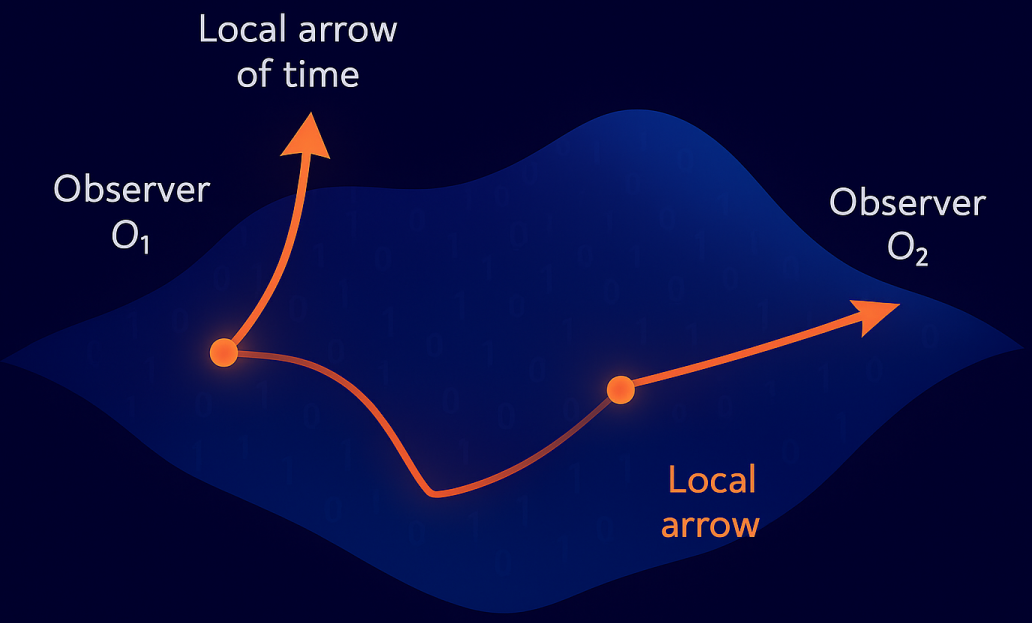
Figure by ChatGPT
The laws of physics, as we know today, seem to have no preferred direction in time. Whether we wonder at the celestial bodies governed by Newton’s equations or follow the undulations of a quantum wave function under Schrödinger’s rule, the mathematics looks the same if we reverse time. Yet, our everyday experience is filled with asymmetry: ice melts, coffee cools, and stars burn their fuel away. The world appears to move forward irreversibly along a temporal arrow that marks the distinction between the past and the future. This tension between the time symmetry of fundamental laws and the irreversible nature of our experience has puzzled thinkers for centuries.
The key to the puzzle was found in the nineteenth century when Ludwig Boltzmann introduced the idea that irreversibility is not a fundamental law but an emergent one. It arises because we, as observers, do not follow every microscopic degree of freedom of a system. Instead, we describe nature statistically, in terms of macroscopic quantities such as temperature and pressure. Entropy, the quantity that famously increases in every natural process, is a measure of how much microscopic detail we ignore. The second law of thermodynamics—the statement that entropy never decreases—is thus not about an absolute cosmic direction of time but about the way information disperses when we lose track of the fine structure of the world.
In recent years, this old insight has been revisited from a radically modern angle. Advances in nonequilibrium statistical mechanics, especially through what are known as fluctuation theorems, have allowed physicists to quantify irreversibility in systems so small that thermal fluctuations are no longer negligible. These theorems tell us that, even though microscopic trajectories are reversible, the probability of observing a process that decreases entropy is exponentially suppressed compared to one that increases it. In other words, irreversibility is statistical, not absolute, but still emerges naturally from time-symmetric laws.
Once this understanding matured in the context of classical and quantum systems, an inevitable question arose: what happens to irreversibility when relativity enters the picture? In other words, when we account for the fact that time itself is relative—that clocks run differently for different observers and that the structure of spacetime constrains what can influence what—how does the arrow of time manifest itself? This is a central question in the direction of extending the thermodynamics of information to relativistic spacetimes, thus taking gravity into account.
Thermodynamics concerns measurements and transformations. When we speak of work, heat, and entropy, we are implicitly describing how an observer interacts with a system over time. In non-relativistic physics, time is an absolute parameter: all observers can agree on what “the beginning” and “the end” of a process are. But in relativity, time is woven into the geometry of spacetime itself, and what one observer calls “simultaneous” may not be simultaneous for another. This simple but profound fact forces us to rethink what we mean by a thermodynamic process.
The standard two-point measurement scheme used to define work and entropy production has been reformulated in this context to respect the causal structure of spacetime. The idea behind this was to anchor measurements along the worldline of a local observer—essentially, the path that the observer traces through spacetime. Each observer has their own clock, their own proper time, and their own access to events within their light cone. With this, it is possible to express fluctuation relations and thus the second law of thermodynamics in a form that remains valid for any relativistic observer, even in curved spacetime.
This new formulation reveals a subtle but striking result: entropy production is not an absolute quantity—it depends on the observer. Two observers in relative motion, or located at different gravitational potentials, will, in general, assign different values to the entropy change of the same physical process. This dependence is not a flaw; it is a manifestation of relativity’s most essential feature: the causal structure of spacetime defines what each observer can access and what remains hidden beyond horizons or light cones. Irreversibility, therefore, is tied not just to what we ignore in a statistical sense, but also to what we cannot, even in principle, observe because of the causal fabric of the universe.
To grasp the physical meaning of this, consider a simple yet vivid example. Imagine two observers watching a small thermodynamic system—say, a charged particle being driven by an electromagnetic field. One observer is stationary, while the other moves rapidly past the system. Because of time dilation, they measure different durations for the same process and disagree on the energy exchanged between the system and the environment. The statistical description of irreversibility, based on these measurements, thus depends on their relative motion. The arrow of time becomes a relational concept: what looks irreversible to one observer may appear slightly different to another, not because physics is inconsistent, but because each observer’s causal horizon defines a distinct partition between accessible and inaccessible information.
At a deeper level, this perspective brings together two pillars of modern physics: thermodynamics and relativity. Both disciplines are, in a sense, about constraints. Relativity constrains what can influence what; thermodynamics constrains how energy and information can flow. When we combine them, a profound unity emerges: the causal structure of spacetime dictates the possible channels of information exchange, and irreversibility arises as a statistical reflection of those causal constraints. Entropy increase is, quite literally, the informational imprint of the universe’s causal order.
This idea resonates with a much broader conceptual movement in contemporary physics, one championed by Carlo Rovelli and others, who propose that time itself might be an emergent property rather than a fundamental background parameter. Rovelli’s "thermal time hypothesis,” developed in collaboration with Alain Connes, offers a remarkable reinterpretation of temporal flow. In quantum statistical mechanics, any physical system described by a state has an associated modular flow—a mathematical transformation that evolves observables relative to that state. Rovelli and Connes suggested that this modular flow is physical time. In other words, time is defined by the statistical state of the universe, not the other way around. Each statistical state generates its own temporal rhythm, its own “thermal time.”
This idea, as abstract as it sounds, fits naturally within the relativistic thermodynamic framework discussed earlier. If irreversibility depends on what an observer can access causally, and if the causal structure itself determines the observer’s notion of simultaneity and duration, then each observer effectively lives in their own thermal time flow. Two observers with different states of information—one seeing a system’s internal details and the other only its coarse macroscopic features—will not only assign different entropies but will, in a deep sense, experience different arrows of time. The flow of time, in this picture, is relational, emergent, and thermodynamic.
To appreciate the beauty of this, one can think of the universe as a vast web of interacting systems, each with its own statistical state. Time is not a universal river flowing independently of its contents, but a tapestry woven from countless local threads of thermal time. Each observer, each subsystem, contributes its own rhythm, and the global sense of temporal direction that we share is an emergent harmony of these local flows. The second law of thermodynamics—entropy increase—is the synchronising principle that gives these threads a consistent orientation: all local arrows align toward greater entropy, even though the microscopic equations themselves do not point anywhere.
The consequences of this viewpoint reach far beyond theoretical elegance. It offers new insight into some of the most mysterious phenomena in physics: the thermodynamics of black holes, the Unruh effect, and the cosmological arrow of time. For instance, an accelerated observer in empty space perceives a thermal bath of particles—the Unruh radiation—while an inertial observer perceives the vacuum. The difference lies in the causal horizon that acceleration creates: part of spacetime becomes inaccessible, and the lost information manifests as heat. In the same way, a black hole’s event horizon hides information, and its entropy reflects that loss. In both cases, thermodynamics emerges from causality—the inaccessibility of certain regions of spacetime.
Seen through this lens, irreversibility is not merely a byproduct of molecular chaos; it is a shadow cast by the universe’s causal architecture. Every horizon, every boundary between what can and cannot be observed contributes to the flow of entropy and, thus, to the perceived arrow of time. The irreversibility we witness is the macroscopic echo of microscopic causal asymmetries—an informational property of spacetime itself.
This synthesis between thermodynamics and relativity also reframes the question of the origin of time. In cosmology, we often ask why the universe began in a low-entropy state or why time appears to have a direction at all. But perhaps these questions are ill-posed. If time is an emergent manifestation of informational asymmetry, then the arrow of time is not something that “began” but rather something that continuously arises from the structure of causal relations. The early universe did not need a special initial condition to set time flowing; time, in this relational view, is constantly redefined by the web of interactions among systems that exchange information and energy.
This approach is remarkable not only for its technical precision but also for its philosophical depth. By embedding fluctuation theorems within relativistic spacetime, we see that the statistical laws of thermodynamics are compatible with Einstein’s geometrical view of the universe. Therefore, this reveals that the directionality of time is not an external feature imposed on the cosmos but an emergent property that depends on how information and causality intertwine.
Ultimately, this line of research invites a new way of thinking about physics. The traditional approach starts with geometry and dynamics—spacetime and forces—and then asks how matter behaves within that stage. The modern informational approach inverts this logic: it starts with what can be known, measured, and transmitted, and lets those informational constraints define the effective geometry and dynamics. From this perspective, thermodynamics and relativity are two aspects of a deeper principle: that the universe is a network of information flows bounded by a causal structure.
Carlo Rovelli has argued that such a relational, information-based view of time is not only compatible with quantum gravity but also necessary for it. In quantum gravity, where spacetime itself becomes subject to quantum uncertainty, the notion of a global clock loses its meaning. Time must then be reconstructed from the relations among systems—from correlations, causal links, and statistical states. The thermal-time hypothesis offers a mathematical framework for this reconstruction, while the relativistic fluctuation theorems provide the operational backbone, showing how the thermodynamic arrow arises in practice. Together, they sketch the outlines of a future synthesis: a physics in which time, causality, and entropy are not separate ideas but reflections of one underlying informational order.
In that vision, the irreversible flow of time that we experience is no longer a mystery to be explained but rather a clue to something fundamental. The warmth we feel, the cooling of a cup of tea, the fading of a memory—all these are manifestations of how information and causality structure the world. The fact that we remember the past and not the future is not an accident; it is the direct consequence of living within a universe whose causal network constrains how information can propagate. Irreversibility is the signature of those constraints made tangible.
And so, the ancient question—why does time seem to flow in one direction?—finds a new and subtle answer. The arrow of time is not written into the equations themselves; it is woven into the fabric of our interaction with the world. It arises because the universe is not entirely visible from any single vantage point. Each observer, bounded by light cones and horizons, experiences a partial view of reality; it is in this partiality that entropy grows. Time’s direction, in the end, may simply be the way in which the universe tells us that no one sees it in its entirety.
Further reading: M. L. W. Basso1, J. Maziero, and L. C. Céleri. Quantum Detailed Fluctuation Theorem in Curved Spacetimes: The Observer Dependent Nature of Entropy Production. Phys. Rev. Lett. 134, 050406 (2025)