Text by Lucas Chibebe Céleri - 06/11/2025
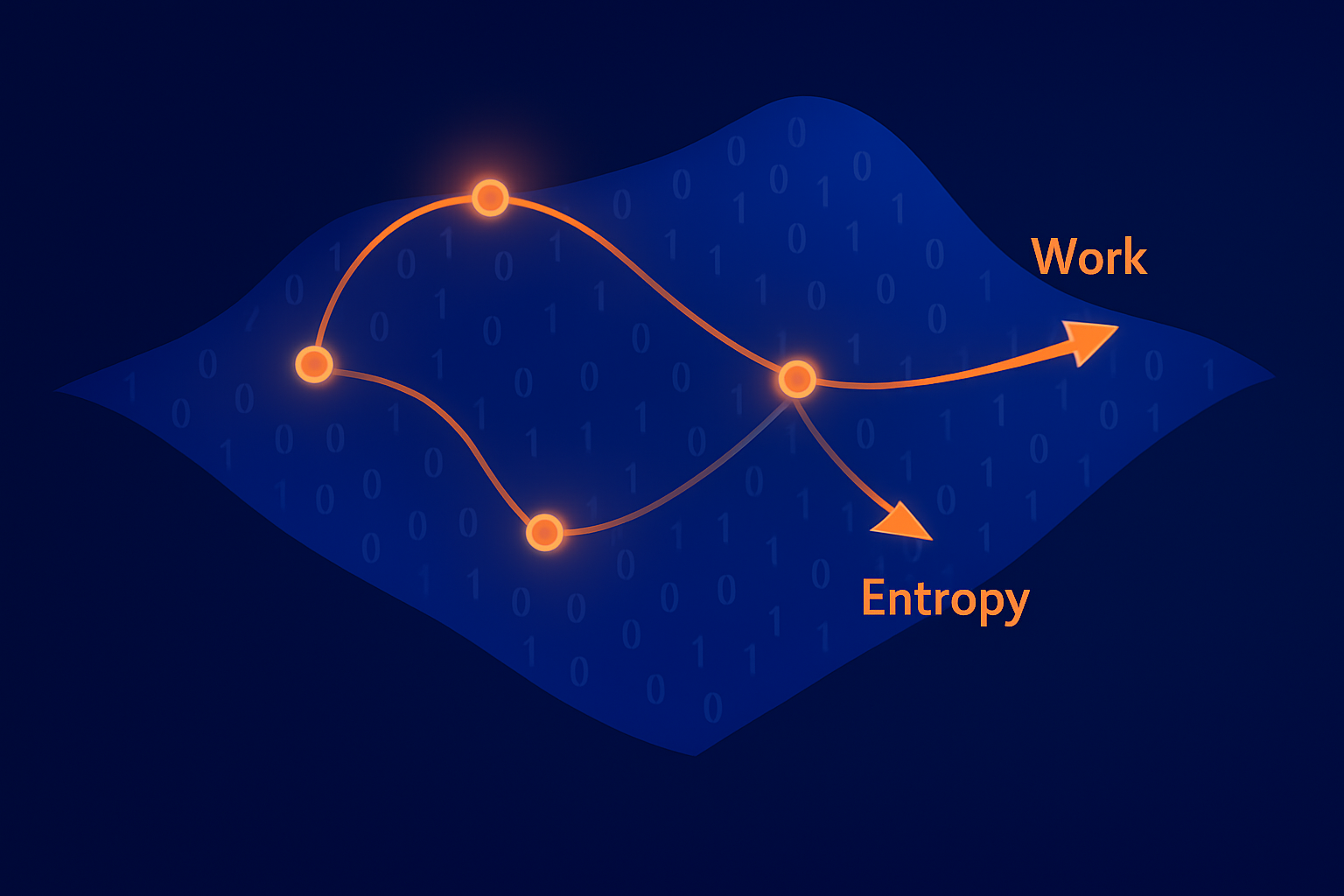
Figure by ChatGPT
In the language of modern physics, gauge theories are the grammar of interaction. They tell us that the laws of nature are not merely equations describing fields and particles, but the manifestation of a deep principle: certain transformations can be performed everywhere in space and time without changing the physical content of the theory. The mathematical name for this principle is local symmetry, and it lies at the heart of our most successful physical frameworks—from electromagnetism to the Standard Model of particle physics. Gauge invariance tells us what must remain unchanged when we shift our mathematical descriptions, and in doing so, it dictates what kinds of interactions and fields must exist.
To see how this works, recall the electromagnetic field. In classical physics, the electric and magnetic fields seem like physical entities in their own right. But Maxwell’s equations can also be expressed in terms of a vector and a scalar potential, quantities that are not directly measurable. They are convenient mathematical tools; yet, they encode the entire dynamics of electromagnetism (and even more!). The key is that we can change these potentials in special ways without altering the observable fields. This is the essence of gauge freedom. The electromagnetic field is not tied to a unique potential; it remains invariant under a family of transformations that shift our description but leave the physical content untouched.
What happens when we take this principle beyond the traditional arena of fundamental physical interactions and apply it to a very different kind of domain, the space of information? The central idea of a new theory is that thermodynamic quantities—work, heat, entropy, and the flow of energy in quantum systems—can be seen as arising from a kind of gauge symmetry that exists not in spacetime but in the informational degrees of freedom that describe how an observer interacts with a system. The answer is nothing less than a gauge theory of quantum thermodynamics, where transformations correspond not to changes of coordinates in space or time but to changes in the informational description of a physical process.
In standard thermodynamics, heat and work are context-dependent. They are not intrinsic properties of a system, but depend on how the system exchanges energy with its surroundings. Similarly, entropy quantifies the lack of information we have about a system’s microscopic state. This dependence on the observer’s knowledge suggests that thermodynamics already carries an implicit gauge structure: different informational “frames” can describe the same underlying physics. What changes between frames is not the total energy, but rather how it is partitioned into meaningful quantities, such as heat or work. This intuition is formalised by treating transformations in information space—changes in the observer’s statistical description of the system—as local gauge transformations.
The state of a quantum system encodes both quantum coherence and classical uncertainty. When an observer acquires or loses information, or when the system evolves under external driving, the state changes accordingly. The key observation is that the space of possible informational descriptions admits transformations that leave the measurable probabilities invariant. These transformations act on the state and on the operator that generates its dynamics, in close analogy to the way phase transformations act on the wavefunction and the Hamiltonian in electromagnetism. Demanding that the theory be invariant under these informational gauge transformations naturally leads to the introduction of a gauge connection—a field defined not in spacetime but in the manifold of states and statistical distributions. This informational connexion ensures that the evolution of the system remains consistent when descriptions are changed, and it gives rise to quantities that we recognise as thermodynamic observables.
From this perspective, work and heat no longer appear as primitive notions but rather as components of a gauge-covariant decomposition of energy exchange. In standard formulations of quantum thermodynamics, distinguishing between work and heat can be ambiguous, especially when coherence or entanglement is present. The gauge approach clarifies this ambiguity by defining work as the change in the system’s energy associated with a “pure gauge” part of the informational connection—analogous to reversible displacements in phase space—while heat corresponds to the part associated with genuine curvature in information space, which cannot be undone by a mere change of description. In the same way that the electromagnetic field tensor measures the curvature of the gauge potential in spacetime, the informational field strength measures the “twisting” of probability space that gives rise to irreversibility and entropy production.
Entropy itself, in this geometric setting, acquires a new interpretation. It becomes a measure of the curvature accumulated along a trajectory in information space: a quantification of how much the observer’s description departs from integrability. In equilibrium, when the system’s evolution is reversible, this curvature vanishes, and the gauge field can be “gauged away.” Out of equilibrium, however, the informational connection acquires nonzero curvature, reflecting the presence of thermodynamic fluxes. This geometric viewpoint unifies energy flow and entropy production as two aspects of a single gauge-covariant structure, much like how electric and magnetic fields are unified in the electromagnetic tensor.
The implications of this idea are profound. If thermodynamics can be formulated as a gauge theory, then its fundamental quantities are not absolute but relational; they depend on how we choose to represent information about the system. The physical content—the measurable probabilities—remains invariant, but the decomposition of energy flow into work and heat changes with the informational frame. This brings thermodynamics conceptually closer to relativity, where quantities like time intervals or simultaneity depend on the observer’s frame of reference, while invariant quantities, like spacetime intervals, remain the same for all. In both cases, the structure of the theory protects consistency under local changes of description, and the appearance of “forces” (be they electromagnetic or thermodynamic) reflects the geometric response of nature to these symmetries.
Beyond its conceptual elegance, this framework opens new avenues for practical understanding. In the quantum regime, where measurement and feedback play crucial roles, distinguishing between energy changes caused by controlled operations (work) and those arising from stochastic fluctuations (heat) is a major challenge. The gauge-theoretic formulation offers a systematic way to make this distinction operationally invariant. It also suggests new ways to define entropy production and identify conditions for reversibility that are independent of any specific representation. In this sense, the curvature in information space plays the role of an intrinsic marker of irreversibility—an invariant signature of thermodynamic time’s arrow.
Perhaps most strikingly, this approach hints at a synthesis between thermodynamics and the geometry of information. If the space of states has a metric structure defined by distinguishability (as in quantum information geometry), and a connection defined by gauge invariance, then the laws of thermodynamics can be seen as the natural dynamics on this manifold. The familiar quantities—temperature, free energy, entropy—emerge as geometric constructs, not imposed by hand but dictated by symmetry. In this picture, thermodynamics is not merely an empirical theory of heat and work but a manifestation of the deeper principle that information and symmetry are two sides of the same coin.
Seen in this light, this does not merely propose a new mathematical formalism; it invites us to reinterpret what thermodynamics truly is. It suggests that the flow of energy and the growth of entropy are not accidents of statistical mechanics, but reflections of a fundamental gauge principle operating in the informational domain. Just as electromagnetism arises from the demand that quantum phases can be chosen freely at each point in spacetime, quantum thermodynamics may arise from the demand that informational descriptions can vary freely at each point in the observer’s knowledge space. The resulting “force” that maintains consistency between descriptions is what we experience as the thermodynamic behaviour of nature.
In the end, this idea carries a philosophical resonance. The frontier between physics and information is becoming increasingly blurred. We have learnt from quantum theory that observation is not passive; the act of acquiring information affects the system itself. Now, by applying the language of gauge symmetry to this very process of description, we may discover that the flow of heat, the performance of work, and the growth of entropy are the dynamical expressions of a much more general symmetry principle—the invariance of the laws of physics under transformations of knowledge. In that sense, the geometry of information might be the next arena where the unification of physical concepts continues, bringing together the language of energy, time, and information under a single, elegant symmetry.
Further reading: G. F. Ferrari, Ł. Rudnicki, and L. C. Céleri. Quantum thermodynamics as a gauge theory. Phys. Rev. A 111, 052209 (2025)