Text by Thiago Henrique Moreira - 12/11/2025
Figure by Gemini
The 20th century witnessed many breakthroughs in the natural sciences, most of which can be summarised in the development of two of the fundamental pillars of modern physics: quantum mechanics, which describes the strange behaviour of microscopic systems, and relativity, which describes the movement of particles that travel at very high speeds, comparable to the speed of light, as well as how astronomically massive objects curve spacetime itself. Both theories seem to work perfectly within their scope, but exploring their intersection has led to intriguing puzzles for quite some time now. One of the many questions concerns whether gravity, and more specifically, the spacetime fluctuations as described by general relativity, can lead to decoherence in quantum systems, which, loosely speaking, amounts to gravity being able to destroy the coherences—the "quantumness"—of a quantum particle and make it behave like a classical one. Now, clearly, this discussion involves some important concepts in both theories, so let us break them down one by one before putting everything together.
Decoherence. Quantum mechanics (QM) is, to this day, our best description of physical phenomena at microscopic scales, and it is famously plagued by some weirdness associated with it. It is very important to emphasise that QM is a completely consistent theory, and its predictions are in good agreement with experimental results at absurdly high precision. The weirdness arises from the fact that quantum systems usually behave in ways that are not expected by our (classically influenced) common sense. Take the famous Schrödinger's cat thought experiment, for instance. The idea is to consider a poor cat inside a closed box that contains a sealed flask of poison connected to a mechanism that can break it. This mechanism is further connected to a Geiger counter that can measure the decay of an unstable atom. If the atom decays, the counter activates the mechanism that breaks the flask and kills the cat. But the laws of quantum mechanics only allow us to compute the probability with which this decay can happen, and until someone opens the box, the cat is described as being in a superposition of alive and dead.
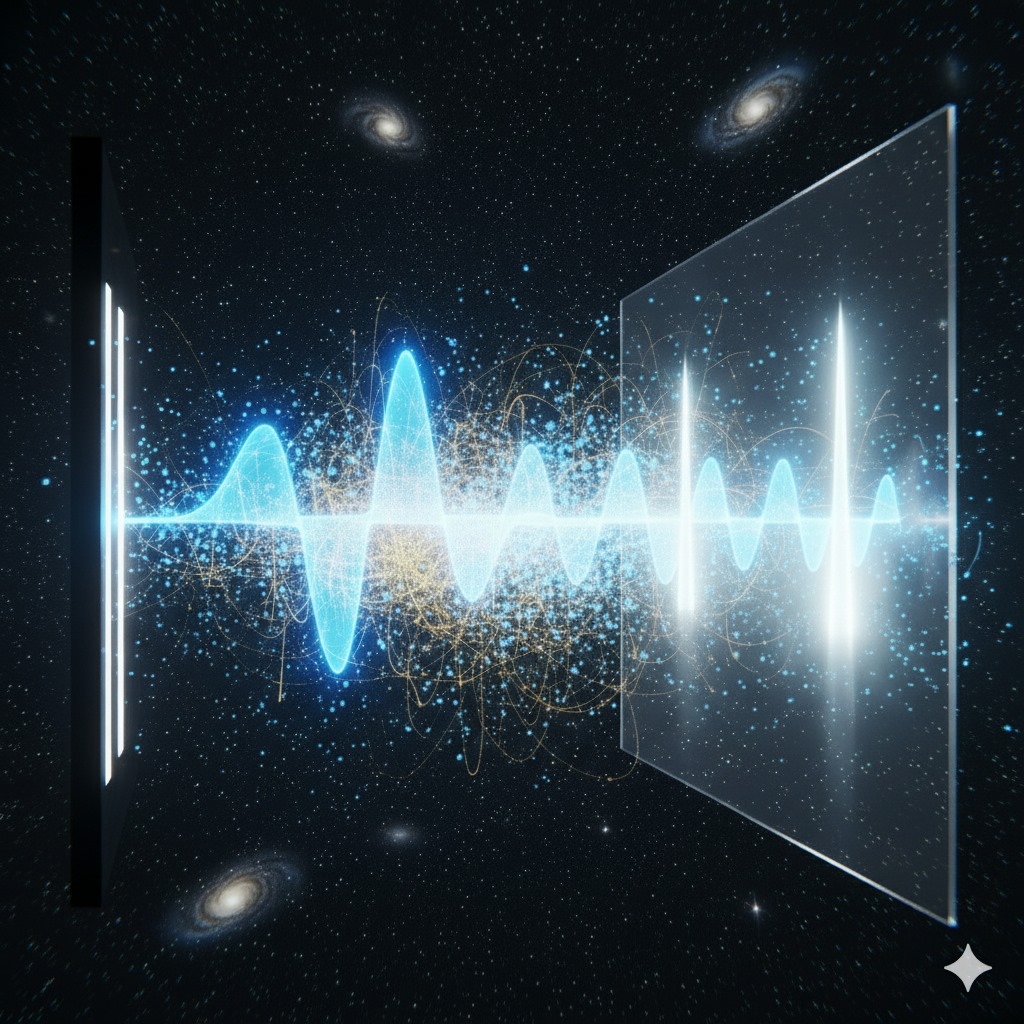
Now, of course, cats do not go around being both alive and dead, but this thought experiment illustrates one core principle of quantum mechanics: the superposition principle. While cats are not observed to be in quantum superposition, quantum particles such as electrons, atoms, and even light molecules can be. For example, if we shoot electrons through a plate that contains only two closely spaced small slits to a detector screen, we will not only see two spots corresponding to passages through either one of the slits, but we will also observe interference patterns (multiple additional spots), just as we see for sound, water, and even light waves. This happens due to the superposition principle, and it seems to lead to the strange and not-quite-precise idea that the electron "passes through both slits" (the alive and dead cat). Of course, we can place a detector at one of the slits to "see which slit the electron passed through". But when we do that, the interference patterns do not appear anymore! (When we open the box, the cat is either alive or dead.)
Let us try to understand this better. Consider this double-slit experiment without any detector at the slits. There are only two possible paths for each electron. It can go through the first slit or the second one. QM states that, to each possibility, we must assign a probability amplitude, which is a number whose square is the probability associated with that possibility. So let us say that each electron has a probability amplitude a of going through the first slit and a probability amplitude b of going through the second one. The total probability amplitude of the electron reaching the detector screen is then simply a+b. But the probability, which is what we actually measure, is (a+b)^2=a^2+b^2+2ab. This is the probability of going through one slit, a^2, plus the probability of going through another slit, b^2, plus a cross-term, 2ab. Such terms are called coherences, and they are responsible for our observation of interference patterns, like waves of probability passing through the slits and interfering just as water waves do, for instance. But interference patterns described by such coherences seem to vanish when we place a detector at either slit; that is, when we acquire what is called "which-path information".
We can investigate this further by considering the same experiment; however, when the electrons pass through the slits, they travel through a low-density gas before reaching the screen. "Gas" is just a short word for "a bunch of particles moving around". The particles in the gas can bump into the traveling electrons, and the denser the gas is—meaning that there are more particles in an arbitrarily small volume—the more collisions actually occur. Why is this interesting? Well, we may not directly measure the electrons before they hit the screen, but we can measure the gas particles that hit them. This measurement can be tricky and sometimes nearly impossible from a practical point of view, but there is nothing fundamental in the theory that prevents us from doing so. But interactions, like collisions, carry information, and this allows us to acquire at least some amount of this which-path information by measuring the gas particles. We can even say that these particles effectively measure the electrons path before they reach the screen. Now, a single particle will not provide enough information to infer which slit the electron has passed through, but perhaps a larger number of particles will do the trick. And we can always increase the gas density in order to have more and more collisions, which will then lead to more and more which path information. So, what happens on the screen? Well, for a very low density of the surrounding gas, the interference pattern of the electrons is still present. But as we increase it (as we slowly open the box containing the cat while trying to get a peek at it), the pattern starts to fade away. If the density becomes large enough (the box is completely open), the coherences vanish completely, and we observe only two spots on the screen (the cat being either alive or dead), as we would for a classical particle passing through the double-slit plate.
The gas represents what we call an environment, which is anything that interacts with the system of interest (the electrons) but whose dynamics we do not care about. The environment seems to destroy the interference patterns coming from the coherences, and we no longer observe quantum superpositions in the system of interest. This is the phenomenon known as environment-induced decoherence or simply decoherence, and it is naturally associated with some kind of "quantum-to-classical transition". For instance, macroscopic systems are generally more subject to interactions with the environment, such as air molecules and dust everywhere, which can lead to decoherence and explain why we do not typically observe basketballs in a superposition of two places at once, or even cats that are both alive and dead. Now, it is crucial to understand decoherence mechanisms not only for their scientific importance but also because of the role they play in the development of quantum technologies. Without coherence, the "quantumness" of such devices will not function as desired, and it becomes fundamentally important to control and mitigate all relevant sources of decoherence. This can be achieved by trying to shield the quantum system from the environmental interactions that can decohere it, which is a formidable task by itself. Although this is usually possible from a fundamental point of view (even if it is not practically feasible with current technology), there is one type of interaction that, although it is relatively weak, cannot be shielded from: gravity.
Spacetime fluctuations. Although its effects have been studied since the times of ancient Greece, the gravitational force only began to be better understood through a proper mathematical formulation by Isaac Newton, following the work of Galileo Galilei in the seventeenth century. It was first modelled as an attractive interaction between massive bodies that explains why we are bound to the Earth, why things fall down, and why the planets orbit the sun. Although Newtonian gravitation is enough to explain such phenomena, it is not the full story. In the 20th century, Albert Einstein developed the general theory of relativity (GR), which taught us that any form of energy curves spacetime, and the effects of this curvature are what we experience as gravity.
Let us try to understand this seemingly complicated yet beautiful theory. First, what is spacetime? Well, in mathematical terms, it is a four-dimensional differential manifold (one dimension for time and three for space), but this is just a fancy way of saying that it is the background on which all matter exists and interacts. The stage of the physics show on which the matter actors perform! But matter carries energy, and GR tells us that this energy curves the background. Now, what does that mean? Well, think of a very energetic matter actor coming onto the stage: spacetime. This energy can be anything, even mass, as shown by Einstein's famous mass-energy equivalence relation. This amount of energy will bend the stage in such a way that a second matter actor will slip towards the first one due to the background curvature. This latter actor may describe such an occurrence as feeling an attractive force towards the former, an interaction called gravity.
GR puts the stage into play. Spacetime is also dynamical, as its properties depend on the matter fields that propagate through it, and the way that matter curves spacetime is dictated by Einstein's equation. It has led to some interesting predictions that were corroborated by experimental results, such as the precession of Mercury's perihelion, the bending of light by gravitational fields, and the existence of gravitational waves, which are ripples in spacetime itself, usually caused by energetically violent events such as the merger of two black holes into a single one. The predictions of general relativity are also fundamental for the precision of the Global Positioning System (GPS). But perhaps more importantly for our discussion, the fact that Einstein's equation of general relativity follows the rules of classical physics is significant.
There are four known fundamental interactions in nature: electromagnetic, strong nuclear, weak nuclear, and gravitational. The former three are endowed with a satisfactory quantum description, namely the Standard Model of particle physics. But whether gravity is to be described by quantum mechanics is still a matter of debate, which can only be resolved by experimental results. Unfortunately, such experiments are beyond the capabilities of current technology. Even from the theoretical side, it is unclear what it means to "quantise spacetime," and there is no consensus on what a theory of quantum gravity should look like. Attempts to quantise gravity include string theory and loop quantum gravity, among many others.
However, for weak gravitational fields, the mathematics is very similar to that describing the electromagnetic interaction, which we know how to quantise. The quantum of electromagnetic waves is composed of particles called photons, which are small energy packets that mediate the interaction between electrically charged particles. By complete analogy, we say that the quantum of gravitational waves is a particle called graviton. These particles, which have not been observed to this day, are expected to exist regardless of a complete theory of quantum gravity if gravity is to be quantized. Such small excitations in weak gravitational fields can then be thought of as representing quantum fluctuations of spacetime itself, just as photons are associated with quantum electromagnetic fluctuations. These guys, however, interact much more weakly than the photons, for instance, which makes them very difficult to detect. But while there are neutral particles in nature—particles with no electric charge that are immune to photons—there are no such entities as gravitons. After all, if all matter actors have to perform on stage, none of them can be immune to its fluctuations, no matter how weak they may be. Now, since there is such a background of particles from which no system can be shielded—a "gas of gravitons"—what does this mean for decoherence in quantum systems? Can gravity be responsible for systems losing their quantumness?
Decoherence and spacetime fluctuations. We are now ready to put everything together by considering the following scenario: take a quantum particle, a light molecule if you wish, and put it in a superposition of different paths (let it go through the double-slit plate, for instance, and measure the interference patterns). Suppose that we can shield this system from any further sources of decoherence, such as interactions with air molecules, for instance. This molecule has mass, it has energy, like everything else, and it will therefore interact with the gravitons. The question is: can the gravitons lead to the decoherence of this system? Well, if we consider the molecule to be a point particle described only by external variables, such as its position, then the answer is: it depends on the mass. If the mass is too big, around $10^{-8}$ kg (this is considered to be very large for a molecule), the answer is yes; gravitons will lead to decoherence. If it is too small, decoherence does not happen, and the system retains its quantumness.
However, molecules are not point particles; in general, they are also described by their internal motion, such as the vibrations of the atoms that constitute them. These vibrations have energy and, therefore, also couple with gravity. If we are only considering the position of the molecule, we do not care about its internal variables, which are regarded as an environment. Basically, we have two kinds of environments: the gravitons and internal motion. The crucial point here is that these environments interact with each other, not only with the system, because gravity is universal. This interaction happens to acquire even more which-path information and, consequently, leads to more decoherence in the system. One can even find regimes in which this decoherence does not depend on the mass of the particle anymore, making it occur even for light microscopic systems.
Of course, such decoherence times are expected to be rather long due to the weakness of the gravitational interaction. Nonetheless, it cannot be avoided, and it raises the question of whether one day, perhaps far in the future, when humankind has completely mastered quantum technologies by mitigating usual decoherence mechanisms, these devices will eventually lose their quantumness anyway due to the inevitable decoherence induced by the quantum fluctuations of spacetime.
Further reading:T. H. Moreira and L. C. Céleri, Decoherence of a composite particle induced by a weak quantized gravitational field, Classical and Quantum Gravity 41, 015006 (2023)